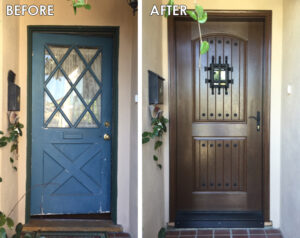
When it comes to any home improvement project, even a simple one like replacing your front entry door, remember this rule:
“It’s not what they say or post, but what they do that matters!”
In a world dominated by overwhelming and sometimes deceptive marketing practices, “It’s not what they say but what they do that matters most” emphasizes the importance of actions over just words or promises. In essence, it means that actions and behaviors by home improvement contractors must accurately reflect their true intentions, values, and character than what they express verbally or in writing.
Homeowners must carefully consider how home improvement contractors behave and represent themselves to ensure they can make informed and financially prudent decisions.
This advice applies to all home improvement projects, including what may seem like a simple project: replacing your front entry door.
How do you know your front entry door should be replaced?
Function: Your wooden door is “out of square” or warped and doesn’t close properly.
Energy efficiency: The front door is drafty. When you move your hand around the door, you can feel hot/cold air coming in
Security: Older doors have inexpensive frames that can be broken with a simple kick.
Aesthetics: The door’s wear and tear makes it look old and unattractive
As a fourth-generation family business, prospects and existing customers often share their negative experiences with home improvement contractors, from “too good to be true discounts” to pressured, hard-sell tactics.
We advise any homeowner considering replacing their front door (or their windows, roof, or siding) to observe how sales reps are doing in their home or on the phone.
So, what are the telltale signs of a complex sale versus a professional presentation?
Is the sales rep spending most of the time talking about themselves or the quickly expiring great deal?
are they focused on educating you about your front door replacement options like insulation, glass, lock styles, etc.?
Is the sales rep engaged in ‘active listening’ to try and understand your wishes and preferences while also carefully studying your home’s current design and aesthetics?
Did the sales rep bring samples of materials and locks?
Does the sales rep provide a detailed breakdown of the total cost to replace your entry door, or do they direct your attention only to the total amount, emphasizing the discount and deadline to take advantage of it?
Does the sales rep focus on “upselling” you on how much more you can save if you add windows, patio doors, etc.?
Although most COVID-related supply chain issues have been resolved, inflation remains a concern for all consumers. However, even though prices have increased, homeowners should maintain their vision and desires for a beautiful home when negotiating a price that fits their budget.
We respect our competitors and recognize that you have many options for home improvements. Still, we urge you to do your due diligence, make informed decisions, and not fall for or get tempted by significant discounts that disguise high-priced products or installations.
In our 104+ years in business, Major Homes has been through recessions, inflations, and other challenges. Our longevity stems from our dedicated team of home improvement professionals, personally trained by the owners, unlike large national brands with multimillion-dollar advertising budgets and a high turnover of sales reps.
Why should you trust us? We would not still be in business and growing if our “word,” how we conduct ourselves, and the quality standards we uphold didn’t meet our customers’ expectations.
Whether you need an honest or second opinion, we are here to help.
The Benefits of Installing Siding on Residential Homes
Siding is a great way to protect your home from the elements, improve energy efficiency, and boost curb appeal. Here are some of the benefits of installing siding for your home:
✅ Insulating Your Home & Protecting it from the Elements:
Well-insulated siding can withstand rain, snow, wind, and hail, keeping your home dry and safe. It can also help to prevent moisture damage to your home’s foundation and framing.
✅ Improved Energy Efficiency:
Well-insulated siding can help to keep your home cooler in the summer and warmer in the winter. As an insulator, vinyl siding minimizes or eliminates air movement through gaps and cracks in your home’s exterior. This is because siding can act as an insulator, preventing heat from escaping during the winter and hot air from entering during the summer. Air infiltration can lead to heat loss in the winter and heat gain in the summer.
✅ Increased Curb Appeal:
With a fresh appearance, your home becomes more enticing to potential buyers, and its overall market value significantly boosts. If you’re considering selling your home, installing siding can increase its value.
✅ Reduced Maintenance: Siding is a low-maintenance material. Unlike wood, it doesn’t require painting or staining, which must be continuously maintained. This can save you time and money on maintenance costs.
✅ Increased Home Value: Generally speaking, homes with new siding can sell for an average of $10,000 more than homes with old or no siding. Siding is a cost-effective way to increase your home’s value and appeals to buyers.
If you’re looking for a way to improve your home’s exterior, siding is a great option. It’s a low-maintenance, durable material that can provide a high return on investment and energy savings.
✅ Return on investment:
Here are some additional details about the return on investment (ROI) for beautifying your home with siding and the added benefit of energy savings when siding is installed on a home:
The ROI for beautifying your home with siding can vary depending on the type of siding you choose, the size of your home, and the installation cost. In general, siding is a relatively inexpensive way to add value to your home by improving your home’s appearance and curb appeal.
✅ Energy Savings When well-insulated siding is Installed on a Home: Siding can help to improve your home’s energy efficiency in several ways.
First, siding can help to keep your home cooler in the summer and warmer in the winter. This is because siding acts as an insulator, preventing heat from escaping during the winter and hot air from entering during the summer.
Second, siding can help to reduce air infiltration. Air infiltration is movement through cracks and gaps in your home’s exterior. This can lead to heat loss in the winter and heat gain in the summer. Siding can help to seal these cracks and gaps, reducing air infiltration and improving your home’s energy efficiency.
Third, siding provides additional ‘insulation’ by helping to reduce the amount of noise that enters your home.
Before you sign a siding contract, consider this!
While the benefits of vinyl siding are clear, their realization hinges on a professional installation.
Engaging an experienced and reputable siding contractor is pivotal. Ensure that your contractor uses digital technology, eliminating guesswork and regrets. You will see your home with different styles and colors before the work begins. Don’t make a decision, especially about colors, in your kitchen. Exterior lighting conditions can dramatically change the way the house will look like.
Prioritizing Quality Installation: Though vinyl siding requires minimal maintenance, proper installation by certified professionals is imperative. Improper installation can lead to water leaks and structural damage. By selecting a reputable installer with a proven track record, you safeguard your investment and ensure long-term enjoyment and a return on your investment. Don’t be tempted by low-cost offers – when it comes to quality materials and installation, “you get what you paid for.”
Proof of Insurance: Before permitting any work on your property, insist on proof of insurance from the installer. This precaution safeguards you from potential liabilities and ensures the installation proceeds without hiccups.
If you’re considering siding for your home or need additional information about your options, please call our siding team at 718.229.5741.
Major Homes has been owned and operated since 1919 at our 4th generation ownership by Mitch and Jason Kersch.
Let’s cut to the chase and address the issue head-on: If you have doubts about installing vinyl replacement windows due to continuous criticism from a self-proclaimed authority on window replacement, it’s time to consider the facts:
Vinyl windows have withstood the test of time and are still the preferred choice for homeowners. They have an undisputed reputation for:
Low Maintenance: Vinyl does not require painting, staining, or regular upkeep to maintain its aesthetic appeal. It offers a hassle-free solution for homeowners seeking convenience and ease of use.
Durability: Vinyl windows are highly resistant to chipping, peeling, rotting, and warping. This inherent durability ensures long-lasting performance throughout the years, saving homeowners time and money. When it comes to practicality and cost-effectiveness, vinyl windows outshine the rest.
To better understand why a well-known brand invests heavily in advertising campaigns that create doubt about vinyl windows we need to discuss marketing and a fundamental principle called: “differentiation” – giving customers a distinct and compelling reason to choose your brand over others.
In this case, if everyone sells vinyl windows at a reasonable price, how can a company justify charging 2x to 3x more? By differentiating by introducing new window ‘material’ that no other manufacturer uses, give it a unique name like “composite” and sow seeds of doubt in homeowners’ minds that anything other than ‘composite’ is inferior.
Changing buyers’ behavior and convincing homeowners to question the use of vinyl and switch to something requires investing millions of dollars into campaigns that inundate the airwaves and digital platforms with advertisements. Homeowners who fall for marketing campaigns stating that “composite” is superior to a material that has been trusted for decades wind up helping to fund these costly campaigns by paying exorbitant prices ranging from $2500 to $3500 per window.
It’s worth noting that windows, like any other product, offer additional options to cater to consumer price or application preferences. For instance, all windows have a Design Pressure (DP) rating, indicating their ability to withstand heavy wind loads and resist external forces that could cause warping. Homeowners in high wind, or storm-prone areas, might choose a vinyl option with a higher DP rating.
Regardless of cost or environmental impact, it is unjustifiable to pay high prices solely to support a marketing campaign that aims to influence consumer behavior by discrediting the tried and tested durability of vinyl.
When it comes to replacement or new windows, vinyl is still a cost-effective option. Even with upgrades, top-of-the-line vinyl windows cost about 70% less than composite materials, including installation.
Don’t be fooled by clever marketing tactics or fancy naming conventions – they don’t justify the drastic price difference.
This isn’t to say that composite windows are bad; some are of decent quality. But it’s important to remember the “Buyer Beware” warning: Don’t get swayed by misleading campaigns that charge 2x-3x premium prices to support a company’s marketing budget.
If you’d like a side-by-side comparison of vinyl windows versus composite options, we invite you to contact our replacement windows team for a no-obligation in-home presentation and demonstration.
Call Major Homes at 877 656-2567. As a 4th generation, 104+-year-old family business, we continue to believe in vinyl and would not be in business if we sold and installed inferior products.
When purchasing home improvement products like replacement windows, roofing, or siding, buyer behavior can be influenced by several factors. One of the biggest challenges for homeowners is selecting a contractor from national brands to local businesses working from their homes, who inundate homeowners with never-ending and confusing offers.
Major Homes has served tens of thousands of Queens and Long Island customers. We are proud that second and even third generations of our original customers back in 1919 continue to choose us for their home improvements. One question we’re often asked is, “What, if anything, has changed about how homeowners decide which home improvement contractor to choose??
Our four generations of experience (and we’re proud to say, unmatched by any company in the NY area) has shown that nothing has changed from a homeowner perspective: This is what they care about by order of priority:
Value. This goes beyond what people think of as the price of the products. Homeowners define value as the quality of the products, price, warranty, and confidence that the contractor will stand behind their work.
The experience dealing with a contractor from the initial inquiry to the signing of a contract. Often, homeowners complain about unprofessional, hard-selling sales reps that spend a minimum amount of time at their homes and focus on “closing the sale” with aggressive discounts that are only available at the time of the visit.
Communications: Are calls or emails answered promptly? Is the contractor genuinely interested in hearing the homeowner’s vision for their home, or are they only interested in selling?
Reputation. Angi’s ratings and Google reviews are relevant and essential. Still, homeowners are not distracted by numbers alone – they often read the reviews and look for customers that share their experience instead of generic comments like “great contractor, highly recommended.”
Technology. Homeowners lose sleep over making the wrong decision and strive for “no regrets” – home improvement projects like replacing windows, roofing, or siding represent a significant decision and investment. Contractors that use imaging technology allow buyers to visualize their home’s appearance before deciding on color or style.
“Our biggest lesson is that homeowners want to be kept from being sold!”
They want to be educated, look at replacement windows, roofing, or siding designs and samples, and understand their choices. They emphasize, time and time again, how important it is for a contractor to connect with them as if it was their house they were investing in.
The home improvement industry is saturated with competitors, especially in the highly congested Queens and Long Island areas. In addition, with unlimited options of windows manufacturers, siding, and roofing materials or designs, when homeowners finally sit down and tackle the task of making a choice, it is riddled with confusion and anxiety.
Homeowners seek objective and reliable differentiation beyond prices, discounts, warranties, and testimonials. Of course, a buying decision is based on the available budget, but more often than not, replacing windows, roofing, and siding is a major investment; Homeowners tell us that seek, and will only do business with, contractors that are genuinely interested in their well-being and that their action and behavior are consistent with their promises.
As a family business, our motto has always been the same for four generations and one hundred and four years in business: Signing a contract is the start of our relationship with a homeowner! Our sales reps don’t disappear after they make the sale, and everyone on our team is trained to deliver professional, consistent, and timely communications to our customers. It takes hard work and determination to deliver this level of service, especially with challenges that are beyond our control (supply-chain delays, weather…) – homeowners demand peace-of-mind and the comfort that their contractor is always there for them.
We invite you to experience what we’ve learned in over one hundred years, and we’re confident you won’t be disappointed.
Welcome, Mitch and Jason Kersch, father and son owners of a 104-year-old home improvement family business. Gentlemen,why do homeowners find replacing windows in their homes overwhelming, confusing, and stressful?
Q: Mitch, you’ve been doing this (as a 3rd generation owner) for fifty-five years. Why are homeowners stressed when it comes to replacement windows?
Mitch Kersch: It starts in February and continues well into the Spring: Your mailbox, inbox, and television screens are flooded with window replacement ads, especially by national brands using their multimillion-dollar budgets. Homeowners have many choices regarding replacement windows, but national brands win regarding frequency and exposure – you can’t escape their ads. So what happens in the mind of the average homeowner who is, as you said, overwhelmed? They do what all of us tend to do when we’re stressed; they just want to “get it over with,” so they pick a recognized brand, thinking it’s the best option.
Jason Kersch: And I’d like to add that there are many other window manufacturers that homeowners have never heard of because they can’t compete with the volume of advertisements by more well-known names with larger budgets. So, we often see homeowners feel compelled to choose anything other than a known brand because they are afraid that if they don’t, they will be making a mistake.
Mitch Kersch: For a homeowner who has not taken the time to explore other options and blindly chooses what they think is a ‘safe option’; installing replacement windows by a major brand, it turns out to be a costly mistake. A replacement window by one big name averages $1,500-$2,000 per window. Even after their aggressive discount, their windows are more than double of an equivalent high-end window by other manufacturers.
Q: For many years, vinyl windows have been the preferred replacement window materials. Some national brands now advertise their composite windows, a hybrid of materials, as the newest and better option. Speaking of being overwhelmed and confused, how do you feel about this?
Jason Kersch: Even though I am a co-owner with my father, I still spend most of my time in sales, meeting and presenting options to homeowners, and because of their multimillion advertising budget, it comes up often. National brands are noticing that educated homeowners are increasingly considering competitive options. To protect their turf, national brands must invent a way to differentiate their windows. The composite materials they brag about are nothing more than recycling waste that is leftover during the manufacturing process of vinyl windows, a combination of wood and vinyl. This recycled waste is not presented as modern technology. It isn’t, and it certainly doesn’t justify paying double or more than existing high-quality windows. Well, recycling leftover materials is a good idea. But there’s nothing sophisticated or high-tech about the composite materials they market.
Q: You chose to align yourself with only one window manufacturer instead of selling/installing any window brand a homeowner might want. Why would you stake your company’s future on one company instead of selling any window?
Jason Kersch: There is a wealth of (mis)information on the internet, which often leads homeowners to feel they have found the best product for their home. Unfortunately, many of these decisions are price-based. At Major Homes, our only goal is to do it correctly the first time, and by default, this eliminates many products on the market because we know they will ultimately fail to perform as expected. If a homeowner has a specific product in mind and feels comfortable with it, we have no problem installing it as long as we know the company and feel confident their product will not fail or require repeated visits. We can say with confidence that with 104 years in this business “we’ve seen it all.”
Our guidelines is simple: the materials that we recommend must meet several criteria in no particular order):
Aesthetically pleasing
Made of heavy gauge materials and with little service needed
When service is needed, the manufacturer is ready and willing to stand by their product
Highly energy efficient, meeting/exceeding all state and local requirements in order to allow homeowners to get tax rebates/credits
Q: After 104 years in the home improvement business, if you had to give a homeowner one piece of advice when it comes to replacing windows, what would it be?
Jason Kersch: You have to answer a few critical questions you need to ask yourself:
Why am I changing the windows?
Do I want to improve/increase energy efficiency?
Do I want my house to have a makeover with modern-looking windows?
Are my windows old and pose a safety hazard? (the locking or sliding mechanism can cause injury when you open or close the window).
Once you can answer and select a vendor, make sure you ask detailed questions of anyone you let into your home. Consider only companies that take the time to bring actual and fully functioning samples. I know this may sound challenging but remove price from the equation when you make a final decision; a replacement window with a very low price can’t offer long term quality and durability. Similarly, a replacement window that costs $1,500-$2000 doesn’t have features that more middle-of-the-range windows offer. You’re most likely subsiding a very expensive marketing campaign.
This is a tried and true quote that works in every area of your home and life:
The Bitterness of Poor Quality Remains Long After the Sweetness of Low Price is Forgotten
Our message to homeowners has been the same throughout the four generations of our family business: Let us educate and guide you, just call with any questions and you’ll be amazed that we actually answer the phone and we always call you back.
Are nationally recognized residential window brands the best, or are there better options?
Hi, my name is Jason Kersch, and I am the 4th generation owner of Major Homes, our family business celebrating 104 years of serving Queens and Long Island homeowners. We’re a couple of months away from the start of Spring and the home improvement season. One question that thousands of homeowners of all ages and demographics always ask us is this:
“I am flooded with commercials and advertisements on TV, radio, in my inbox, and my mailbox by a few major window brands. When I go to Home Depot or Lowes, they advertise the same names. Are their windows better, or are national brands everywhere simply because they have big marketing budgets?”
Perhaps the first thing that comes to your mind when reading an article written by a home improvement company is, “here we go; they are going to sell me something.” That is not our goal, and I’m proud to say that our family never engages in underhanded tactics or promotions disguised as informative articles.
We share this information because my family has always believed that educated homeowners are our best customers. We always ensure that homeowners (who are not construction or home renovation experts) are aware of their options – especially when tempted to buy replacement windows from a major brand because it is well-known.
Some homeowners may think it’s worth spending a small fortune on replacement windows because they’ve heard about “Brand X.” While on the one hand, this is not an unreasonable assumption, the brand is well known because the company can spend millions to ensure that homeowners think of their brand when it’s time to replace their windows.
I’m not saying that replacement windows by national brands are inadequate or inferior products. Replacing the windows in your home is a major investment, and this is a valid question:
Does a nationally recognized brand offer the best value for my money, or are they just counting on me to make a ‘safe’ buying decision because, “it must be good because I’ve heard and I’ve seen their commercials everywhere.”
Consider the following:
Option 1: The average cost for a nationally recognized window brand can cost $1,500-$3,000 per window. The manufacturer offers a limited lifetime warranty, no-interest financing, and claims that the materials and construction of their window are better than vinyl (the most widely used material in windows).
Option 2: A lesser-known brand of replacement windows typically costs $500-$800 per window and offers the same warranty and financing. This material is vinyl.
If a homeowner were considering replacing ten windows, their total investment would be:
$15,000 for a national brand (using the lowest price of the above range)
$5,000 for the lesser-known brand (using the higher-end price of the above range)
When you choose a national brand, which on average will cost 50% more than something lesser-known, the manufacturer has a smaller advertising budget and relies mostly on word-of-mouth referrals. Are you getting 50% more value, assuming the warranties and financing are the same?
Absolutely not.
Here’s a quick lesson in marketing:
What do you do if everyone sells vinyl replacement windows (the most common and proven material for many years), but you want to charge 50% more for your windows? One way is to introduce new material and claim that it is better than 95% of other well-established products using vinyl. If you’re a well-known national name, you back up your claims with multimillion-dollar advertising campaigns.
What about replacement windows sold by Home Depot and Lowes?
Their prices are even lower than everyone else since national brand manufacturers provide box retailers with a low-cost version of the same national brand to enable them to compete and offer a low-cost alternative. The national brand versions of windows sold by home improvement retailers are different and often have cheaper materials and construction to allow retailers to compete.
You get what you pay for.
What about 0% financing or other offers?
Think about your car shopping experience!
What is the first question a car salesperson asks? “Are you leasing or financing?” The question isn’t designed to provide the best value; it tells the rep how to price the car to the dealer’s advantage. If a customer only focuses on the monthly payment, car dealers make a small fortune by leasing the car at full MSRP. When customers opt not to finance, they negotiate a much lower price before committing.
Financing replacement windows is no different: National brands will push zero interest and no financing for x years to take your eyes off the total investment: they want you to focus, just like when you lease a car, on the monthly payment instead of the total investment and getting the best value for your money.
What national brands know more than most is the psychology of human behavior; a homeowner would rather not take a risk on an unknown brand name and settle for a false comfort that “if everyone is buying this brand, it must be good.” By avoiding the anxiety of choosing wrong, they are not making a rational decision and, in the process, overspend on replacement windows.
How should homeowners resolve this replacement windows buying decision: “expensive well-known brand vs. the alternatives?”
Window replacement sales reps use pressure tactics when they sit in your kitchen. Take your time, and make an informed decision by comparing window brands.
Understand the difference between window materials: Vinyl is still proven durable and the best value for your money.
Don’t fall for monthly financing deals (remember the car leasing example). Look at the price of each window.
Read the contract carefully and understand what is and is not included in the final price.
Only consider established and reputable window replacement contractors. Window manufacturers do not install windows. If you have a warranty claim, your replacement windows contractor will have to do the work; longevity (how long they’ve been in business) is the most important indicator of the company’s reputation and integrity.
Conclusion:
Don’t rush or get tempted by too-good-to-be-true replacement window offers.
Make an informed decision when it’s time to replace the windows in your home.
The windows in your home will constantly remind you whether you made a smart buying decision.
If you feel pressured by discounts or financing deals that expire soon, walk away; it’s too expensive to make a bad decision for something you should be enjoying in the next twenty years.
Call Jason Kersch (718-229-5741) if you want honest and unbiased advice from a company that has been replacing windows for 104 years. You will hear back from us typically within minutes – it’s part of our commitment, respect, and appreciation of your time and, most importantly, the big decision you are about to make.